Wad Inserting Machine: Working, Types, Uses & Buying Guide
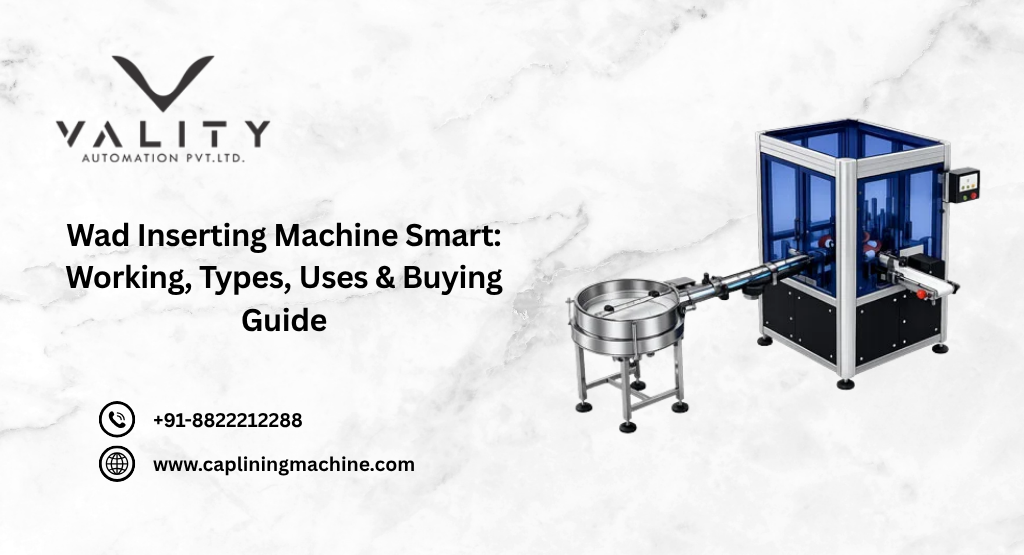
A Wad Inserting Machine is used to automatically or semi-automatically place a wad or liner inside a bottle cap. It helps packaging manufacturers improve insertion consistency, reduce repetitive manual work and maintain a smoother ion process. The Wad Inserting Machine Smart is a suitable automated solution where controlled cap and wad handling is required.
What Is a Wad Inserting Machine?
A Wad Inserting Machine is packaging equipment designed to insert a suitable wad or liner into a bottle cap. Wads are commonly used as part of a cap-and-container packaging system where controlled liner placement is required.
Instead of manually placing each liner inside a cap, the machine uses feeding, positioning and insertion mechanisms to perform the repetitive operation.
Depending on the machine configuration and application, compatible liner materials can include EPE wads, induction wads, foam, paper and foil-based liners.
For packaging manufacturers handling a large number of caps, automated wad insertion can provide better process consistency and reduce dependence on repetitive manual handling.
How Does a Wad Inserting Machine Work?
The working process of a wad insertion machine generally involves cap feeding, wad feeding, positioning, insertion and discharge.
1. Cap Feeding
Caps are supplied to the machine through a suitable feeding arrangement. The feeding system helps organise the caps and move them toward the insertion station.
2. Cap Orientation
The caps are positioned in the required orientation so that the insertion mechanism can perform the operation correctly.
3. Wad Feeding
The required liner or wad is supplied to the insertion section. The feeding arrangement depends on the type, size and characteristics of the selected wad.
4. Wad Insertion
The machine places the wad inside the cap through a controlled insertion mechanism. Consistent positioning is important for maintaining uniformity throughout the ion process.
5. Processed Cap Discharge
After the wad is inserted, the processed cap moves toward the discharge section or the next stage of the packaging operation.
In an automatic wad inserting machine, these operations are coordinated through an automated control system to reduce manual intervention.
Wad Inserting Machine Smart for Automated Cap-Lining Operations
The Wad Inserting Machine Smart is designed for applications where manufacturers need an organised and automated approach to wad insertion. By combining cap handling and liner-placement operations, the machine can help reduce repetitive manual work and maintain a more consistent ion workflow.
The suitability of the machine depends on the actual cap dimensions, wad material, liner size, required ion output and packaging process.
Before selecting a machine, manufacturers should provide accurate application details so that the appropriate configuration can be evaluated.
Why Is Automatic Wad Insertion Important for Packaging Production?
Manual wad insertion can become repetitive and difficult to maintain consistently when ion volumes increase. An automated process can help organise this operation and provide more repeatable results.
The main advantages can include:
- Reduced repetitive manual handling
- Consistent wad placement
- Improved ion workflow
- Better operational efficiency
- Reduced labour dependency
- More controlled cap handling
- Improved suitability for continuous ion
The actual ion improvement depends on factors such as cap dimensions, liner material, machine configuration, ion speed and operating conditions.
Types of Wad Inserting Machines for Different Applications
Different packaging operations have different requirements, so machine configurations can vary.
Automatic Wad Inserting Machine
An Automatic Wad Inserting Machine is designed for automated cap and liner handling with reduced manual intervention. It can be considered for ion environments where repetitive wad insertion is performed at higher volumes.
Semi-Automatic Wad Inserting Machine
A semi-automatic configuration may be suitable when manufacturers want to automate the insertion operation while retaining some manual handling within the process.
Cap Liner Inserting Machine
A Cap Liner Inserting Machine focuses on placing a compatible liner inside a cap. The machine configuration depends on the liner material, cap dimensions and required ion process.
Plastic Cap Wad Inserting Machine
This type of application is intended for suitable plastic caps where a compatible wad or liner needs to be positioned inside the cap.
Customized Wad Inserting Machine
A customized machine can be considered when standard configurations do not match the required cap dimensions, liner material, ion speed or packaging-line arrangement.
Which Materials Can Be Used With a Wad Inserting Machine?
The suitable wad material depends on the packaging application and machine configuration.
Common liner materials may include:
- EPE
- Induction wads
- Foam
- Paper
- Aluminium foil-based liners
The dimensions, thickness, flexibility and handling characteristics of the liner can affect machine selection.
Therefore, it is important to provide the manufacturer with the exact wad material and dimensions before finalising the machine configuration.
Wad Inserting Machine Applications Across Packaging Industries
A Wad Inserting Machine can be used in packaging operations where bottle caps require an internal liner or wad.
Pharmaceutical Packaging
Pharmaceutical bottles can require controlled cap and liner assembly. Automated wad insertion helps maintain consistent positioning during repetitive packaging operations.
Food and Beverage Packaging
Food and beverage containers may use compatible liners as part of their packaging requirements. Automated cap handling can support repetitive ion processes.
Cosmetic Packaging
Cosmetic bottles and containers often require organised cap assembly. Wad insertion can form part of the preparation process before final container closure.
Chemical Packaging
Chemical s may use caps with suitable internal liners. Automated insertion provides a controlled way to prepare these caps for subsequent packaging operations.
Pesticide Packaging
Pesticide containers can require specific cap-and-liner arrangements. A suitable wad insertion system can automate the liner-placement stage.
FMCG Packaging
High-volume FMCG packaging operations can benefit from automation when repeated cap-liner insertion is part of the ion workflow.
Key Features to Consider When Selecting a Wad Inserting Machine
The right features depend on the ion requirement, but several factors deserve attention when evaluating equipment.
Automated Cap Feeding
An automated feeding arrangement can reduce repetitive manual cap handling and provide a continuous supply to the insertion station.
Controlled Wad Placement
Consistent placement is important when the liner needs to sit correctly inside the cap.
Automated Controls
PLC-based controls can coordinate different machine operations and maintain the required ion sequence in suitable automatic configurations.
Wad Feeding System
The feeding mechanism should be compatible with the selected wad material, size and physical characteristics.
Cap Size Compatibility
Cap diameter, shape and internal dimensions should be checked before selecting a machine.
Production Configuration
The machine should be selected according to the required ion output, available space, automation level and integration requirements.
How Does a Wad Inserting Machine Improve Production Efficiency?
The main purpose of automation is to make repetitive operations more consistent and manageable.
A Wad Inserting Machine can help by mechanising cap feeding and liner placement instead of relying entirely on manual insertion.
This can provide practical benefits such as:
- Less manual intervention
- Consistent repetitive operations
- Better ion flow
- Reduced operator dependency for insertion
- Improved process organisation
- Greater suitability for continuous operations
However, machine efficiency should always be evaluated against the actual ion requirement rather than relying only on a general machine speed claim.
What Specifications Should You Check Before Buying?
Before purchasing a Wad Inserting Machine, review the machine parameters against the actual packaging application.
| Requirement | What to Check |
|---|---|
| Cap type | Plastic or application-specific cap |
| Cap dimensions | Diameter, shape and internal dimensions |
| Wad material | EPE, induction, foam, paper, foil or other compatible material |
| Wad dimensions | Diameter and thickness |
| Production requirement | Required output per minute or hour |
| Automation | Automatic or semi-automatic |
| Feeding | Cap and wad feeding arrangement |
| Controls | PLC/HMI requirements where applicable |
| Installation | Available floor space |
| Integration | Connection with existing packaging equipment |
| Maintenance | Accessibility and routine servicing |
| Customization | Special ion requirements |
Providing accurate information about the cap and liner allows the manufacturer to evaluate the appropriate machine configuration.
How to Choose the Right Wad Inserting Machine?
Choosing the right machine starts with understanding the complete ion process.
Check Your Cap Dimensions
The cap diameter, shape and internal opening influence feeding and insertion requirements.
Identify the Wad Material
Confirm the liner material, size, thickness and physical characteristics before selecting the equipment.
Define Production Output
Determine how many caps need to be processed per minute, hour or shift. This helps identify the required machine configuration.
Select the Automation Level
An automatic system can be considered for continuous ion, while a semi-automatic solution may be suitable for operations with some manual handling.
Consider Available Space
Check the machine footprint and available installation area before finalising the equipment.
Evaluate Integration Requirements
If the machine needs to work with cap assembly, filling, closing or other packaging equipment, integration should be considered during machine selection.
Discuss Maintenance and Support
Ask about maintenance procedures, spare parts, installation assistance and technical support before purchasing.
What Affects Wad Inserting Machine Price?
The Wad Inserting Machine Price varies according to the machine configuration and ion requirements.
Factors that can influence the overall cost include:
- Automation level
- Production capacity
- Cap size and type
- Wad material and dimensions
- Feeding mechanism
- Control system
- Machine construction
- Customization
- Additional automation
- Integration with other equipment
For this reason, there is no single machine price suitable for every application.
When requesting a Wad Inserting Machine quotation, provide the manufacturer with your cap specifications, wad details, ion requirement and automation expectations. This makes it easier to determine a suitable configuration and provide a relevant quotation.
When Should You Consider a Customized Wad Inserting Machine?
Customization becomes useful when your ion requirements do not match a standard machine configuration.
A customized solution may be considered for:
- Special cap dimensions
- Specific wad materials
- Different liner sizes
- Particular ion speeds
- Existing packaging-line integration
- Limited installation space
- Special automation requirements
- Specific cap assembly processes
The purpose of customization should be to make the equipment suitable for the actual ion process rather than adding features that are not required.
Why Work With an Experienced Wad Inserting Machine Manufacturer?
The machine is only one part of an automated packaging solution. The manufacturer's engineering and application understanding can also influence machine selection and long-term operation.
When evaluating a Wad Inserting Machine Manufacturer, consider:
- Machine design and engineering capability
- Manufacturing and fabrication
- Assembly process
- Machine testing
- Application understanding
- Customization capability
- Installation and commissioning
- Spare-parts support
- Maintenance guidance
- Technical assistance
For buyers searching locally, terms such as Wad Inserting Machine Manufacturer in Ahmedabad, Wad Inserting Machine Manufacturers in Gujarat and Wad Inserting Machine Manufacturers in India reflect different geographic purchasing requirements.
Wad Inserting Machine Manufacturer in Ahmedabad, Gujarat, India
Ahmedabad is an important industrial and engineering centre, making it a relevant location for companies looking for packaging machinery manufacturers.
Vality Automation Pvt. Ltd. manufactures Wad Inserting Machines in Ahmedabad and provides packaging machinery solutions for cap assembly and related operations.
For buyers in Gujarat, the search may be focused on a Wad Inserting Machine Supplier in Gujarat, while companies purchasing from other regions may search for manufacturers or suppliers across India.
For export requirements, buyers may also evaluate a Wad Inserting Machine Exporter in India based on machine configuration, application suitability, technical support and delivery requirements.
The most important consideration remains whether the machine matches the required cap, wad, ion output and packaging process.
Wad Inserting Machine Manufacturing, Testing and Support
A packaging machine typically goes through several stages before it becomes part of a ion line:
Design → Engineering → Fabrication → Assembly → Testing → Installation → Commissioning → Maintenance
Before purchasing, discuss the expected machine configuration, testing process, installation requirements and maintenance procedures with the manufacturer.
For a customized Wad Inserting Machine, application details should be confirmed before manufacturing. This includes the cap dimensions, wad material, liner size, ion requirement and integration requirements.
Frequently Asked Questions About Wad Inserting Machines
What is a Wad Inserting Machine used for?
A Wad Inserting Machine is used to place a compatible wad or liner inside a bottle cap. It automates or semi-automates the repetitive cap-lining process.
What is Wad Inserting Machine Smart?
Wad Inserting Machine Smart is an automated wad insertion solution intended for controlled cap and liner handling. Its suitability depends on the cap type, wad material, dimensions and required ion process.
How does an Automatic Wad Inserting Machine work?
It generally feeds and positions caps, supplies the required wad, inserts the liner into the cap and transfers the processed cap to the next stage of the packaging process.
Which industries use Wad Inserting Machines?
Applications can include pharmaceutical, food, beverage, cosmetic, chemical, pesticide and FMCG packaging, depending on the cap and liner requirements.
What types of wads can be inserted?
Depending on the machine configuration, compatible materials may include EPE, induction wads, foam, paper and foil-based liners.
Can a Wad Inserting Machine handle different cap sizes?
Machine configurations can be selected or customized according to the required cap and wad dimensions. The exact compatibility should be confirmed with the manufacturer.
What information is needed for a Wad Inserting Machine quotation?
Manufacturers generally need information about the cap type, cap dimensions, wad material, wad diameter, ion requirement, automation level and packaging-line integration.
What is the difference between automatic and semi-automatic wad insertion?
An automatic machine performs the required feeding and insertion operations with greater automation, while a semi-automatic machine retains some manual handling within the process.
What should I check before buying a Wad Inserting Machine?
Check cap compatibility, wad material, ion requirement, insertion process, automation, feeding system, installation space, maintenance requirements, technical support and integration with your existing packaging line.
Choose the Right Wad Inserting Solution for Your Packaging Process
A Wad Inserting Machine can help packaging manufacturers automate repetitive liner-placement operations while improving consistency and ion workflow. The correct equipment depends on the cap type, wad material, ion output, automation level and application.
If you are evaluating an Automatic Wad Inserting Machine for pharmaceutical, food, cosmetic, chemical, pesticide or other suitable packaging applications, discuss your actual ion requirements with the manufacturer before selecting the configuration.
For machine enquiry, customization or quotation, share your cap size, wad material, required ion output and application with Vality Automation Pvt. Ltd. to discuss a suitable solution for your packaging process.

