Wad Inserting Machine Pro for Accurate Cap Lining
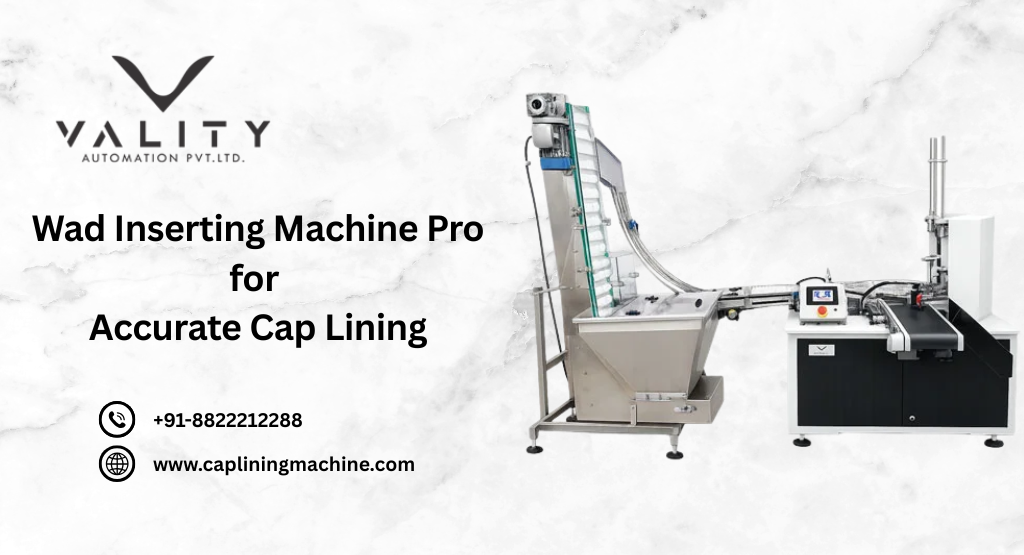
Wad Inserting Machine Pro is an industrial automatic cap-lining solution designed to place wads or liners accurately inside bottle caps before the capping and sealing process. By automating cap feeding, positioning, wad placement and discharge, it can reduce manual handling, improve insertion consistency and support continuous packaging operations.
Wad Inserting Machine Pro for Faster and More Consistent Cap Lining
A Wad Inserting Machine Pro is designed for manufacturers that need a controlled method of inserting liners or wads into caps at ion scale. The machine is also commonly described as a cap lining machine, cap wadding machine, cap liner insertion machine or cap wad inserting machine.
The basic purpose is straightforward: caps are fed and positioned, the wad is picked or supplied to the insertion station, and the liner is pressed into the cap before the finished caps are discharged for subsequent packaging operations.
Depending on the machine configuration, wad insertion can involve a vibratory bowl or other cap-feeding arrangement, rotary indexing, a wad magazine or feeding mechanism, vacuum pick-and-place and an insertion or pressing station.
For buyers evaluating an automatic wad inserting machine, the important consideration is not simply speed. Cap compatibility, wad type, changeover requirements, insertion accuracy, automation level, inspection requirements and integration with the existing packaging line all influence the right configuration.
How Does a Wad Inserting Machine Pro Work?
The working process generally follows a controlled sequence:
- Cap feeding: Empty caps are supplied through a suitable feeding system.
- Cap orientation: The caps are arranged in the required orientation.
- Indexing: Each cap is accurately positioned at the wad insertion station.
- Wad feeding: Pre-cut wads or liners are supplied from a magazine or suitable feeding arrangement.
- Wad picking: A vacuum or mechanical mechanism can pick the individual liner, depending on configuration.
- Insertion: The wad is positioned and pressed into the cap.
- Inspection or detection: Optional sensors or vision systems can identify missing or incorrectly positioned wads.
- Discharge: Completed caps move toward collection or the next packaging operation.
Rotary indexing and star-wheel arrangements are commonly used to maintain controlled cap positioning during insertion. Different machine designs may use single, double or multiple insertion heads according to the required ion configuration.
This controlled sequence makes an industrial wad inserting machine more suitable for repetitive ion than manual liner placement.
Wad Inserting Machine Types for Different Production Requirements
The right machine configuration depends on the cap design, liner material, ion requirement and level of automation.
Pre-Cut Wad Inserting Machine
Pre-cut systems use already prepared wads or liners that are supplied individually through a magazine or feeding arrangement. Vacuum-based pick-and-place systems are commonly used for transferring pre-cut liners into caps.
This configuration can be suitable when the liner is already available in the required size and shape.
Single-Head Wad Inserting Machine
A single-head cap wad inserting machine is generally suited to ion environments where a moderate output is required and a simpler insertion configuration is preferred.
Double-Head Wad Inserting Machine
A double-head arrangement can support higher ion requirements by providing additional insertion capability. The actual output depends on cap dimensions, liner characteristics, machine configuration and operating conditions.
Roll-Fed Wad Inserting Machine
Roll-fed systems can combine liner punching and insertion within the machine. In such systems, the liner material is supplied from a roll, punched according to the required format and then inserted into the cap. Some industrial systems use 1-up, 2-up or 3-up punching arrangements for different ion requirements.
The choice between pre-cut and roll-fed technology should therefore be based on the customer's liner supply method and ion process rather than simply selecting the fastest machine.
Key Features That Improve Wad Insertion Accuracy
A well-configured automatic wad inserting machine can include several mechanisms that contribute to controlled ion:
- Automatic cap feeding
- Vibratory or rotary cap feeder
- Cap indexing and positioning
- Rotary indexing or star-wheel mechanism
- Wad magazine or liner feeding system
- Vacuum pick-and-place arrangement
- Pneumatic or mechanical insertion mechanism
- No-cap/no-wad control
- Wad detection sensors
- Reverse-wad detection where applicable
- Counting system
- Vision inspection as an optional configuration
- Adjustable change parts for different cap formats
- HMI and automated controls, depending on machine configuration
Such features are intended to reduce manual intervention and maintain repeatable positioning throughout the ion cycle. Commercial machine designs in this category commonly offer options such as cap elevators, vibratory feeders, sensors, vision inspection and automatic rejection systems.
How Wad Inserting Machines Reduce Manual Cap Lining Problems
Manual wad placement can become difficult when ion volumes increase or when every cap needs consistent liner positioning. An automated system addresses this repetitive operation through controlled feeding, positioning and insertion.
More Consistent Wad Placement
A dedicated insertion mechanism can position the liner in a repeatable manner instead of relying on manual placement.
Lower Manual Handling
Automation reduces the amount of repetitive cap handling required from operators, particularly in continuous ion environments.
Better Production Control
Automated feeding, indexing and counting can make the cap-lining process easier to monitor and integrate with other packaging operations.
Reduced Risk of Missing Wads
Sensors or inspection systems can be incorporated where detection of missing or incorrectly positioned liners is important. Some commercial systems specifically provide no-wad and reverse-wad detection options.
Easier Integration
A wad insertion system can be positioned as part of a broader cap assembly or packaging line, depending on the required process sequence.
Wad Inserting Machine Applications Across Packaging Industries
The application of a cap lining machine depends largely on the type of container, closure and liner being used.
Pharmaceutical Packaging
Pharmaceutical bottles and healthcare packaging can require controlled liner placement before the cap is applied. Wad insertion equipment can therefore be used as part of a broader bottle closure and packaging process.
Food and Beverage Packaging
The technology is relevant to bottles and containers used for s such as edible oils, sauces, beverages and other packaged foods where a liner or induction sealing component forms part of the closure system.
Cosmetic and Personal Care Packaging
Caps used for cosmetic, personal-care and household s may require internal liners or wads. Automated insertion helps manufacturers manage repetitive cap-lining operations.
Chemical and Agrochemical Packaging
Industrial chemicals, cleaning s, lubricants and agrochemical packaging can use lined closures where controlled sealing is required. Machine configuration should be selected according to the chemical environment, cap design and liner specification.
FMCG and General Packaging
High-volume consumer packaging can benefit from automated cap feeding and liner insertion where manual handling would otherwise become a ion bottleneck.
Which Wads and Caps Can a Wad Inserting Machine Handle?
There is no single universal liner configuration for every ion line. The machine needs to be matched to the actual closure and wad specification.
Commonly encountered liner categories include:
- Induction sealing wads
- EPE liners
- Foam liners
- Pre-cut liners
- Roll-fed liner material
Industry machine designs also demonstrate compatibility with different cap sizes and configurations, but the exact range depends on the selected machine and change parts.
Before ordering, manufacturers should provide the cap drawings or samples, liner dimensions, liner material and ion target so the appropriate insertion mechanism can be evaluated.
Production Specifications to Consider Before Buying
Instead of selecting a machine based only on advertised speed, evaluate the complete ion requirement.
Important considerations include:
| Production factor | Why it matters |
|---|---|
| Cap diameter and geometry | Determines feeding, indexing and change-part requirements |
| Wad/liner type | Influences feeding and insertion mechanism |
| Wad thickness | Can affect picking and insertion performance |
| Required output | Helps determine single, double or higher-head configuration |
| Cap orientation | Affects feeder and indexing design |
| Automation level | Determines operator involvement |
| Inspection requirement | May require sensors, cameras or rejection |
| Available floor space | Influences machine layout |
| Utilities | Electrical and pneumatic requirements should match the facility |
| Changeover frequency | Important for plants handling multiple cap formats |
| Line integration | Determines conveyor, counting and downstream connectivity |
Published industry examples show that wad insertion systems can range from moderate-output pre-cut machines to higher-output roll-fed configurations, demonstrating why machine selection should be based on the actual application rather than a generic capacity figure.
Customized Wad Inserting Machine for Different Cap Formats
A customized Wad Inserting Machine can be considered when standard configurations do not match the customer's cap, liner or ion process.
Customization may involve:
- Cap feeding arrangement
- Change parts
- Number of insertion heads
- Liner feeding method
- Cap size range
- Sensor configuration
- Vision inspection
- Rejection mechanism
- Counting system
- Conveyor arrangement
- Line integration
- Automation and control requirements
For example, a manufacturer handling several cap formats may need dedicated change parts and tooling rather than a completely different machine for every closure.
Customization should be finalized after reviewing actual cap and liner samples, ion speed, process sequence and available utilities.
How to Choose the Right Wad Inserting Machine
Choosing the right Wad Inserting Machine Pro starts with the ion process rather than the machine name.
1. Define the Required Output
Determine the number of caps required per minute or per shift. A higher target may justify multiple insertion heads or a roll-fed configuration.
2. Confirm Cap and Liner Compatibility
Share the cap dimensions, cap geometry and liner specifications before finalizing the machine.
3. Select the Right Feeding System
Vibratory, rotary, elevator, magazine and other feeding arrangements can be selected according to cap design and ion requirements.
4. Decide the Required Inspection Level
If missing, reversed or incorrectly positioned wads are critical quality concerns, consider sensors, vision inspection and automatic rejection.
5. Consider Changeover Requirements
If several cap sizes are produced on the same line, ask about change parts, adjustment time and tooling requirements.
6. Check Line Integration
The machine should fit logically with upstream cap handling and downstream operations such as counting, capping or sealing.
7. Evaluate Maintenance and Support
Access to spare parts, technical support, installation, commissioning and maintenance guidance can affect the long-term usability of the equipment.
What Determines Wad Inserting Machine Price?
The Wad Inserting Machine price depends on the machine configuration rather than one fixed market rate.
Key cost factors include:
- Automatic or semi-automatic configuration
- Required ion speed
- Single or multiple insertion heads
- Pre-cut or roll-fed liner system
- Cap feeder arrangement
- Number of cap formats
- Change parts and tooling
- Sensor and inspection systems
- Vision system
- Automatic rejection
- Control architecture
- Conveyor and line integration
- Custom engineering requirements
For this reason, requesting a quotation based on the actual cap, wad and ion requirement gives a more meaningful comparison than comparing machine prices alone. Industry listings also show substantial variation in advertised prices and configurations.
Why Consider a Wad Inserting Machine Manufacturer in Ahmedabad, Gujarat or India?
For businesses searching for a Wad Inserting Machine Manufacturer in Ahmedabad, the important factor is not location alone but access to engineering, fabrication, customization, testing and technical support.
Ahmedabad and Gujarat have an established industrial and machinery-manufacturing ecosystem, making regional sourcing relevant for buyers evaluating packaging automation.
A manufacturer in India can also be evaluated for:
- Machine design and engineering
- Fabrication and assembly
- Application-specific customization
- Factory testing
- Installation and commissioning
- Spare parts availability
- Maintenance support
- Domestic supply
- Export-oriented machine supply
For buyers searching Wad Inserting Machine Manufacturers in Gujarat, Wad Inserting Machine Manufacturer in India, Wad Inserting Machine Supplier in Gujarat or Wad Inserting Machine Exporter in India, the evaluation criteria should remain the same: machine suitability, engineering capability, quality control, service responsiveness and total operating value.
Manufacturing, Testing and After-Sales Support Matter
A packaging machine is not only a collection of mechanical components. Its practical performance depends on how the feeding, indexing, liner handling, insertion and control systems work together.
A professional manufacturing process should therefore address:
Design → Fabrication → Assembly → Alignment → Control Integration → Testing → Installation → Commissioning → Support
Before dispatch, the machine should be evaluated against the agreed application requirements. Where possible, testing with actual caps and liners provides more useful validation than testing with generic components.
After installation, operators should understand machine operation, changeover procedures, cleaning, inspection points and routine maintenance. Spare parts and technical support should also be considered when evaluating a long-term packaging automation investment.
Frequently Asked Questions About Wad Inserting Machine Pro
What is a Wad Inserting Machine?
A Wad Inserting Machine is an automated packaging machine that places a wad, liner or sealing insert inside a bottle cap or closure. It is also commonly called a cap lining machine, cap wadding machine or cap liner insertion machine.
What is a Wad Inserting Machine used for?
It is used to automate the placement of liners or wads inside caps before the caps proceed to subsequent packaging, capping or sealing operations.
How does an automatic wad inserting machine work?
The machine generally feeds and orients caps, indexes them into the insertion position, supplies the liner, inserts or presses the wad into the cap and then discharges the completed caps.
Is a Wad Inserting Machine the same as a Cap Lining Machine?
In industrial packaging terminology, wad inserting machine, cap lining machine, cap wadding machine and cap liner inserting machine are often used for closely related equipment performing the same basic cap-liner insertion function.
Can the machine handle different cap sizes?
Potentially, but the supported range depends on the machine design, tooling and change parts. Cap samples and dimensions should be reviewed before confirming compatibility.
Can a Wad Inserting Machine be customized?
Yes. Depending on the application, customization can involve cap feeding, insertion heads, liner feeding, change parts, sensors, inspection, rejection and line integration.
What industries use cap wad inserting machines?
Common applications include pharmaceutical, food and beverage, cosmetic and personal care, chemical, agrochemical, edible oil and FMCG packaging.
What should I provide when requesting a quotation?
For an accurate quotation, provide the cap sample or drawing, liner/wad details, required ion output, number of cap formats, preferred automation level and any inspection or line-integration requirements.
Get the Right Wad Inserting Machine for Your Production Line
Selecting the right Wad Inserting Machine Pro is ultimately about matching the insertion technology to the cap, liner, ion volume and packaging process. A properly configured system can automate repetitive cap-lining work, improve consistency and create a more controlled ion workflow.
If you are evaluating an automatic Wad Inserting Machine, cap lining machine or customized cap-liner insertion solution, discuss your cap dimensions, wad specifications and ion target with the manufacturer before finalizing the machine configuration.

